
From Fire-Affected Landscape to a Measurable Restoration Process
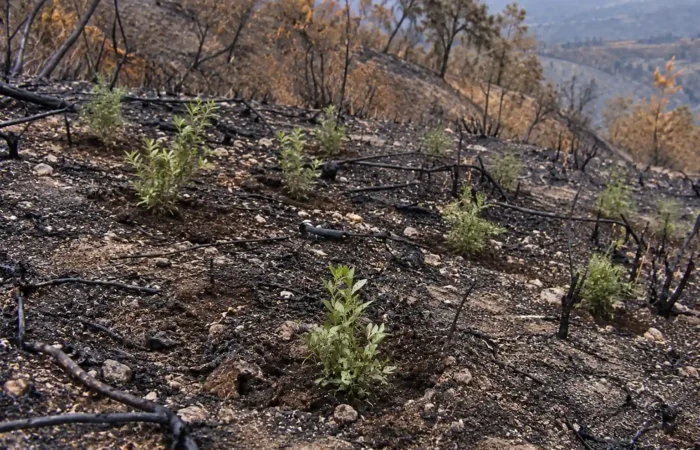
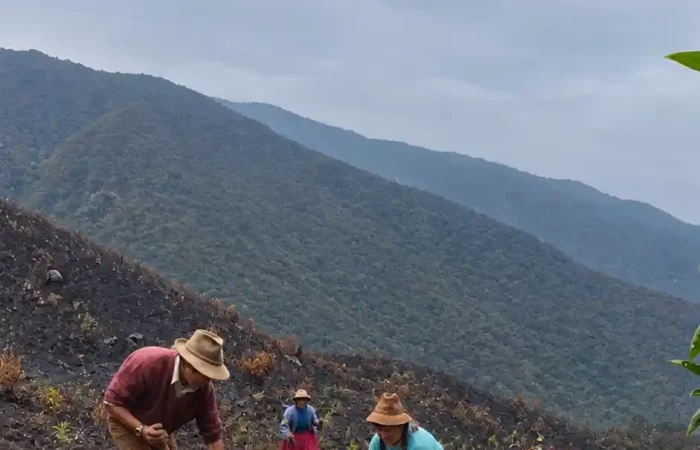
On August 3, 2026, a wildfire affected territory where REFOREST TREES develops restoration actions. The event altered part of the landscape and created a new challenge: how to support ecological recovery while strengthening the community connected to that territory.
The response did not begin with the assumption that planting trees alone would solve the problem. Post-wildfire restoration requires assessment, planning, appropriate intervention, community participation, maintenance, and monitoring.
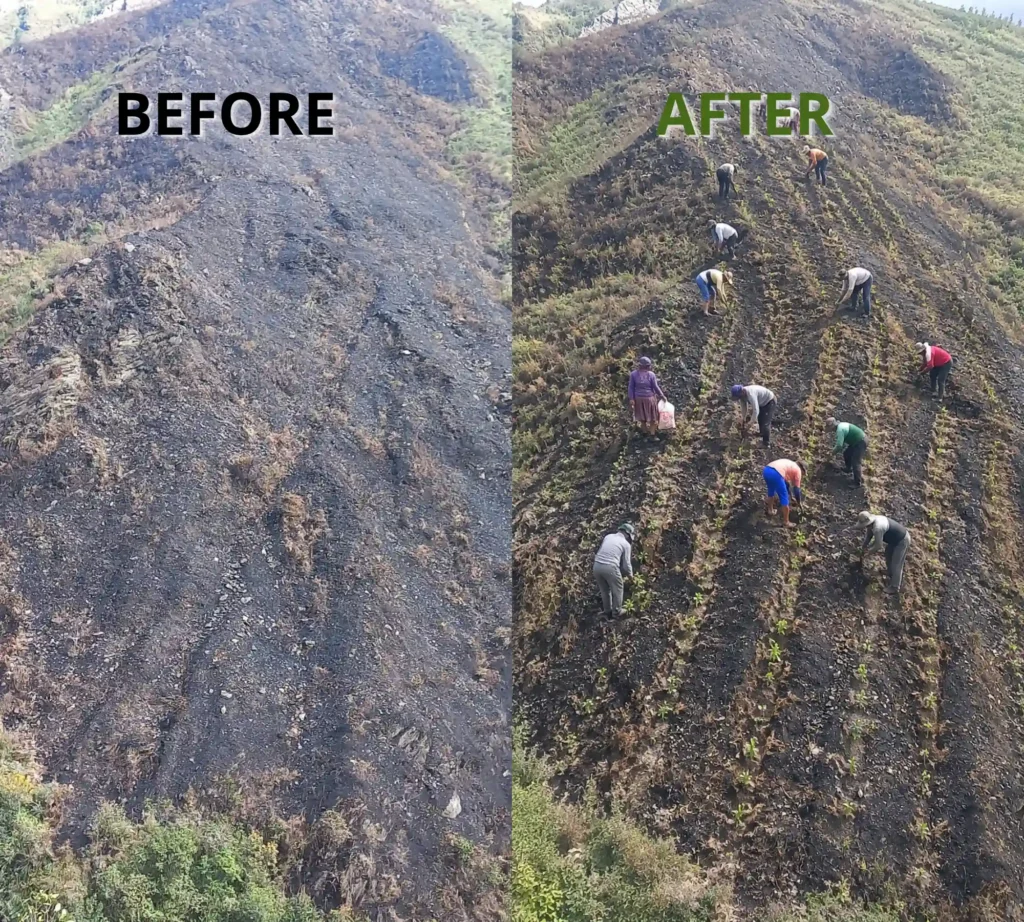
The before-and-after perspective is therefore more than a visual comparison. It represents two moments within a longer process:
Wildfire → Impact → Community Response → Restoration → Monitoring → Recovery
The “after” image should not be interpreted as proof of complete ecological recovery. It represents a stage in an ongoing restoration process.
What Changes After a Wildfire?
Wildfire can affect vegetation structure, biomass, habitats, soils, biodiversity, hydrological processes, and the carbon stored in ecosystems. The severity and consequences vary according to fire characteristics and local ecological conditions.
Recent scientific research emphasizes that vegetation, soil, and hydrological recovery can occur at different rates following wildfire. Recovery is therefore a temporal process rather than a single event.
This distinction matters.
A photograph can show that vegetation has been established or that people are actively working on a site. It cannot, by itself, establish survival rates, growth rates, biomass, carbon storage, or percentage of ecological recovery.
Those indicators require field measurements and appropriate monitoring methods.
Why the “Before and After” Needs Scientific Context
A responsible restoration organization must distinguish between visual evidence and measured evidence.
The photographs can document visible changes in the landscape and the presence of restoration activities. Scientific monitoring can determine how the ecosystem is actually progressing.
Depending on the restoration objectives, relevant indicators may include:
- plant survival and mortality;
- height growth;
- stem diameter or DBH where appropriate;
- vegetation cover;
- natural regeneration;
- species composition;
- soil condition;
- biomass;
- carbon stocks;
- georeferenced field observations;
- changes documented through repeated imagery.
These measurements allow restoration teams to move from a simple visual narrative to evidence-based adaptive management.
Restoration After Fire Is Not Simply Tree Planting
One of the most important principles in forest restoration is that planting should follow ecological assessment—not replace it.
Some affected areas may have sufficient natural regeneration to recover with protection and appropriate management. Other areas may require active restoration because ecological barriers prevent adequate recovery.
FAO recognizes assisted natural regeneration as an approach that can facilitate natural succession by addressing barriers such as soil degradation, competing vegetation, and recurring disturbances. Its suitability depends on ecological and social conditions, including the presence of regenerating seedlings, seed sources, protection from disturbance, community support, and local capacity.
Where active restoration is appropriate, decisions can include species selection, site preparation, erosion control, planting, maintenance, and protection.
Scientific restoration therefore asks a more important question than “How many trees were planted?”
It asks:
“What ecological functions need to recover, and what evidence shows that recovery is occurring?”
The Community Is Part of the Restoration
The response to the August 3, 2026 wildfire is also a community process.
REFOREST TREES is working together with the local community to progressively recover and restore the affected area. Community members can contribute to field activities, restoration work, maintenance, environmental monitoring, education, prevention, and local stewardship.
This participation is important because restoration is more sustainable when the people connected to the territory have an active role in its recovery.
FAO guidance on assisted natural regeneration emphasizes the importance of community involvement, social support, incentives, and participation in planning and implementation for long-term restoration success.
The relationship can be understood as:
Community → Work → Restoration → Knowledge → Monitoring → Resilience
This approach also creates opportunities to connect ecological recovery with green employment, technical capacity, local participation, and sustainable rural development.
Forest Recovery and the Carbon Cycle
Forest restoration is also connected to the global carbon cycle.
Through photosynthesis, growing vegetation removes carbon dioxide from the atmosphere and incorporates carbon into organic matter. As vegetation develops, carbon can be stored in aboveground biomass, belowground biomass, and, depending on ecosystem conditions and measurement boundaries, soils and other carbon pools.
However, planting a tree does not automatically establish a specific quantity of carbon dioxide removal.
Carbon claims require a defined methodology, measurements, assumptions, monitoring periods, and appropriate verification.
For this reason, REFOREST TREES should communicate carbon impact according to evidence rather than converting a photograph or planting activity directly into a predetermined carbon figure.
Monitoring Makes Restoration More Accountable
A credible restoration program should be able to answer fundamental questions:
Where is restoration occurring?
What ecosystem is being restored?
Which species are being used?
When did restoration activities occur?
Who is participating?
How are plants maintained?
How is survival and growth monitored?
What indicators demonstrate progress?
Digital monitoring and geospatial tools can strengthen this transparency.
Open Forest Protocol, for example, provides tools for ground monitoring, verification, and transparent presentation of forest-project data. Explorer.land provides map-based project documentation, geolocated updates, and data layers that can help restoration organizations communicate project context and progress. GainForest provides tools for community-linked environmental observations and verifiable records, including geospatial and remote-sensing approaches.
These technologies do not replace field science or community knowledge. They can complement them.
The “After” Is Not the End
The most important message behind a before-and-after image is not that restoration has already been completed.
It is that recovery is underway.
The burned landscape represents the impact of the August 3, 2026 wildfire. The later image represents a subsequent stage in which people are actively participating in restoration.
Between those two moments lies the work that cannot be captured in a single photograph: assessment, planning, species selection, site preparation, planting where appropriate, maintenance, monitoring, learning, and continued community participation.
FAO describes wildfire recovery as potentially involving both ecological restoration and the recovery of community assets, livelihoods, and employment. UNDRR similarly frames recovery as restoring or improving environmental, social, economic, physical, and livelihood systems while reducing future disaster risk.
That is the broader purpose of restoration.
From Visual Change to Long-Term Resilience
The strongest restoration story is not simply before versus after.
It is:
Evidence → Action → Monitoring → Learning → Adaptation → Recovery
REFOREST TREES understands forest restoration as a process connecting ecological science, community participation, environmental education, green opportunities, monitoring, and climate action.
The wildfire created a serious challenge. The response creates an opportunity to restore ecosystems while strengthening the capacity of the community to protect and manage its territory over time.
The landscape is recovering progressively.
The work continues.
And the next stage should be measured—not assumed.
Support the Restoration Process
Supporting post-wildfire restoration means supporting a process that combines community action, ecological science, monitoring, and long-term resilience.
The recovery began in the territory. You can help be part of the restoration process.