
Scientific methods used to quantify carbon capture in reforestation and ecological restoration initiatives
Understanding how the carbon footprint is measured in forest projects is fundamental to credible climate action. In the context of climate science, a carbon footprint represents the total amount of greenhouse gases—primarily carbon dioxide (CO₂)—associated with human activities or systems. Forest restoration projects play a critical role in mitigating climate change by capturing and storing atmospheric CO₂, but the environmental value of these projects depends on rigorous measurement and transparent verification.
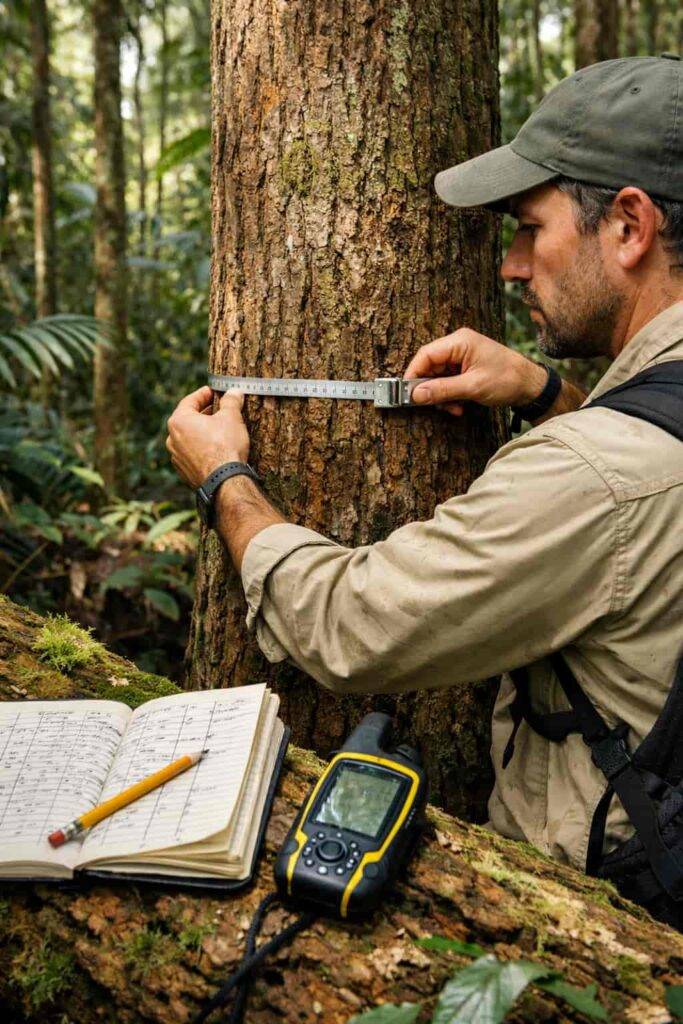
In reforestation and ecological restoration projects, the measurement of carbon capture follows internationally recognized methodologies based on forest science and climate accounting. These approaches quantify the amount of carbon stored in ecosystems and track how restoration activities contribute to long-term climate mitigation.
One of the most important components is the measurement of forest biomass. Trees absorb CO₂ through photosynthesis and convert it into organic carbon stored in their tissues. Scientists estimate this storage by measuring tree diameter, height, and species characteristics during forest inventories. Using established allometric equations, these measurements allow researchers to calculate aboveground biomass, which represents the carbon stored in trunks, branches, and foliage.
Equally important is belowground biomass, which refers to carbon stored in root systems. Although more difficult to measure directly, standardized models are used to estimate root biomass based on aboveground measurements. Together, aboveground and belowground biomass represent a major portion of forest carbon storage.
Another critical reservoir is soil organic carbon. Forest soils store significant amounts of carbon accumulated through decomposing organic matter and root activity. Soil sampling and laboratory analysis allow scientists to determine the amount of carbon stored in soil layers, providing a more complete understanding of ecosystem carbon dynamics.
To ensure accuracy, forest projects rely on Monitoring, Reporting and Verification (MRV) systems. MRV frameworks integrate field data, statistical models, and remote sensing technologies. Satellite imagery and geospatial monitoring help track forest growth, canopy cover, and land-use changes over time. Combined with ground-based measurements, these tools allow scientists to estimate how much CO₂ is captured as forests grow and ecosystems recover.
These measurement systems are essential not only for scientific integrity but also for building credible climate solutions. Transparent carbon accounting ensures that restoration projects generate verifiable environmental benefits and contribute meaningfully to global climate mitigation efforts.
Beyond environmental outcomes, measuring the carbon footprint of forest projects also supports sustainable development. Reliable climate data allows organizations to design projects that generate green jobs in rural communities, strengthen local economies, and protect ecosystems that provide water regulation and soil stability.
Scientific measurement therefore connects ecological restoration with social impact and climate accountability.
Discover how we measure the climate impact and carbon capture of our restoration projects at:
https://reforestrees.org/one-dollar/
By supporting transparent, science-based restoration initiatives, institutions and individuals can contribute to climate solutions grounded in measurable environmental impact.