Ecological restoration demands transparent, traceable, and empirically verifiable documentation.
To achieve this, Reforestrees uses Explorer.land, a leading geospatial platform that visually documents conservation and restoration activities through interactive maps and georeferenced field evidence.
Explorer.land is utilized by:
WWF
Rainforest Alliance
The Nature Conservancy
REDD+ implementers
Global conservation NGOs
Its adoption reinforces our commitment to scientific transparency and field-level accountability.
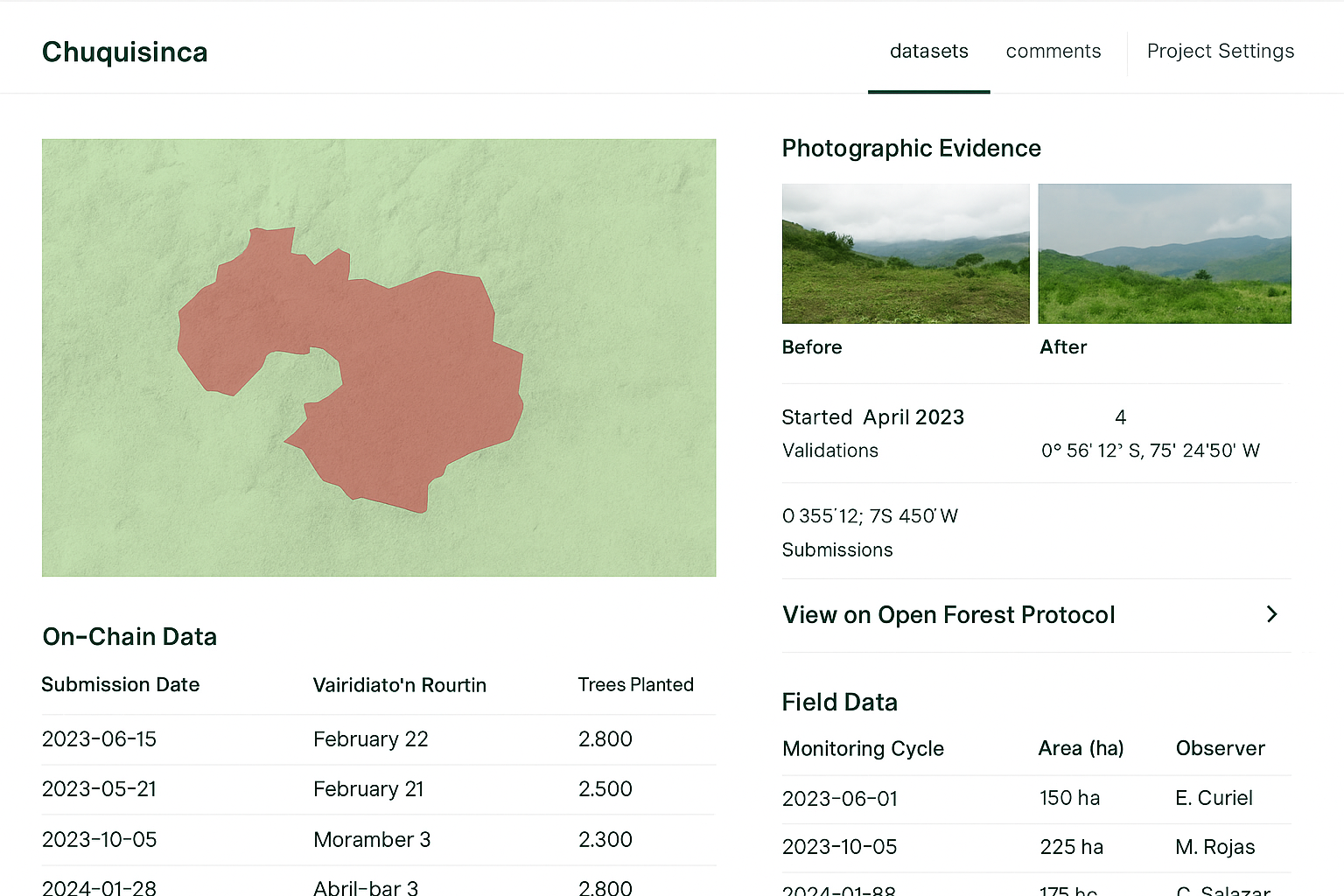
Explorer.land is a spatial documentation and visualization platform that integrates:
Georeferenced photographs
Interactive geospatial maps
Polygon-based project boundaries
Time-stamped field evidence
Community and ecological narratives
Continuous spatial monitoring
The platform enables stakeholders to see our work as it happens, offering a high level of transparency and geospatial accuracy.
Our methodology follows industry best practices for ecological monitoring, spatial analysis, and environmental reporting:
Step 1. Precise spatial delineation
We map our intervention areas using accurate polygons and geospatial layers.
Step 2. Georeferenced photographic evidence
Photos are captured with GPS-embedded metadata to ensure verifiable geographic authenticity.
Step 3. Operational activity documentation
Recorded evidence includes:
Native species planting
Seedling care and maintenance
Regeneration monitoring
Community participation
Nursery activities
On-site ecological restoration practices
Step 4. Publication on Explorer.land
Data are uploaded to interactive project pages that allow users to navigate field evidence at parcel level.
Step 5. Continuous updates
Field evidence is updated periodically to reflect seasonal progress, maintenance cycles, and ecological outcomes.
Independent visual verification
Field images provide proof of authenticity, reducing uncertainty and enhancing credibility.
✔ Socio-ecological context
Documentation highlights community involvement, biodiversity, and land-use practices.
✔ Open accessibility
Stakeholders can independently assess progress without intermediaries.
✔ Complementarity with blockchain verification
Explorer.land provides visual verification;
OFP provides cryptographic, on-chain validation.
Together, they create a dual transparency layer unmatched in traditional restoration projects.
Explore our restoration sites, field photographs, polygons, and activity logs here:
https://explorer.land/x/organization/ret/projects
This interface offers a high-resolution, scientifically valuable geographical representation of our project areas.
Through Explorer.land, Reforestrees provides a rigorous and independently verifiable geospatial record of our environmental restoration activities.
When combined with our on-chain MRV using Open Forest Protocol, this creates a comprehensive transparency framework that aligns with the highest scientific, ethical, and operational standards in global ecological restoration.